
The Rosette nebula (NGC2237-9) surrounds the open cluster NGC2244 in Monoceros. According to Burnham´s Celestial Handbook it is located at a distance of about 2600 lightyears and has a diameter of about 55 lightyears. Read More
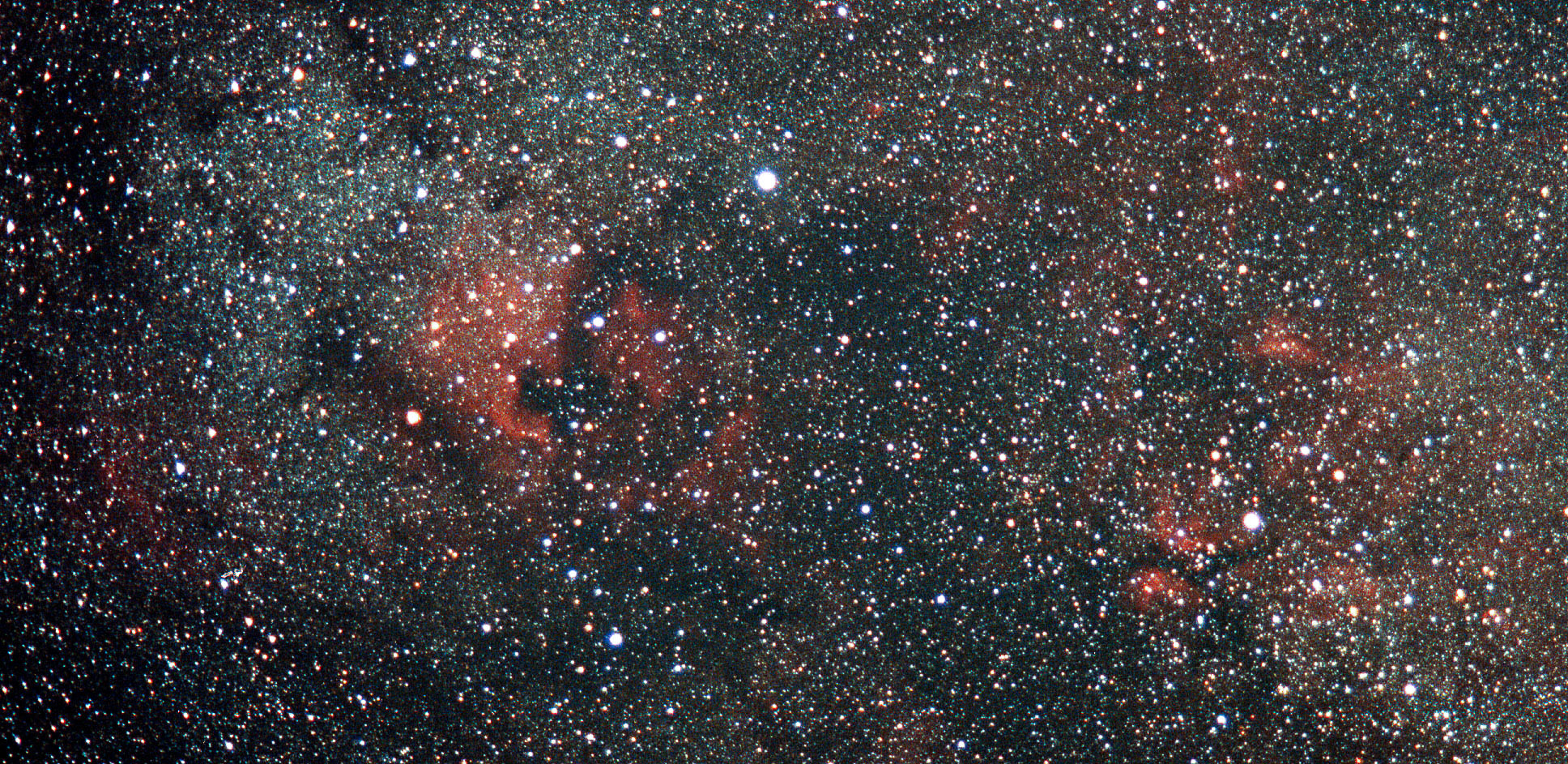
Nebulosity in Cygnus
Comet Hale Bopp from the balcony

| Film: | Kodak Royal Gold 400 |
| Telescope/Lens: | Nikon 35mm f/2 |
| Exposure: | 2 min at f/2 |
| Date: | 30 March 1997 |
Comments: This picture was taken in the vicinity of Pazin in Istria/Croatia during a short easter holiday.This image was made from the balcony of our apartment.
Hale Bopp with Tree

| Film: | Kodak Royal Gold 400 |
| Telescope/Lens: | Nikon 35mm f/2 |
| Exposure: | 2 min at f/2 |
| Date: | 29 March 1997 |
Comments: This picture was taken in the vicinity of Pazin in Istria/Croatia during a short easter holiday. The tree was illuminated using a small flashlight.
Comet Hale Bopp

Comet Hale Bopp with North America Nebula

| Film: | Kodak Royal Gold 400 |
| Telescope/Lens: | Nikon AF 85mm f/1,8 |
| Exposure: | 7 min at f/1,8 |
| Date: | 9 March 1997 |
Comments: Comet Hale Bopp and the North America nebula in Cygnus. Some high clouds, which were not visible to the eye show up in lower left corner. A satellite trail is visible between the comet and the North America nebula.
Comet Hale Bopp and Mitch

| Film: | Kodak Royal Gold 400 |
| Telescope/Lens: | Nikon 35mm f/2 |
| Exposure: | 20 sec at f/2 |
| Date: | 9 March 1997 |
Hyakutake – wideangle

| Film: | Kodak Technical Pan |
| Telescope/Lens: | Nikon 35mm f/2,0 |
| Exposure: | 15 min at f/2,8. |
| Date: | 24 March 1996 |
Comments: I developed the Film in a print developer, which resulted in very hight contrast. The hight contrast is good for the comet, but it enhances the vignetting very much. I used my Super Polaris mount, without guiding corrections. I lined out the big dipper, to give you a scale of perspective on the lenght of comet Hyakutakes tail. At the point, where the tail intersects with the handle of the big dipper a patch can be seen. It seems that it represents a part of the comet, which disconnected earlier.
Hyakutake, 300mm

| Film: | Kodak Technical Pan |
| Telescope/Lens: | Nikon 300mm f/2,8 |
| Exposure: | 15 min at f/2,8. |
| Date: | 24 March 1996 |
Comments: I developed the Film in a print developer, which resulted in very hight contrast. The hight contrast is good for the comet, but it enhances the vignetting very much. I used my Super Polaris mount, without guiding corrections. Because of that, the stars are point-like, but the comet (which moved during the exposure) shows no detail.